



Are you seriously considering getting into Electric mountain bike, but between the models, the technical options and the sometimes obscure jargon, do you feel like you're reading Chinese? Don't worry, you're not alone! This little guide is here to help you see things more clearly and make the right choice.
Le electric mountain bike - or Electric mountain bike for those in the know – is attracting more and more cyclists, whether they are beginners, weekend adventurers or seasoned riders. And for good reason: it offers the promise of long rides, thrills and freedom, all with a welcome boost on the climbs.
Why Consider an Electric Mountain Bike? (Even If It Wasn't in Your Plans)
Electric mountain biking sometimes gives rise to preconceptions. Some perceive it as a compromise reserved for those who want to pedal "without pushing too hard," or as a solution for cyclists who are losing shape. However, when you take the time to try it, you quickly realize that it's much more than that.
An electric mountain bike doesn't replace effort, it complements it. It allows you to push your limits without necessarily exceeding them. The climbs become easier, the distances less intimidating and above all, each outing becomes an opportunity to fully enjoy the moment without fear of overdoing it.
This type of bike opens up new perspectives. It allows you to rediscover the joy of pedaling thanks to a feeling of freedom and increased control. For many, it's a true revelation: the pleasure of riding becomes central again, with the promise of long, beautiful rides.
What are the criteria to take into account?
Now let's get down to business. Choosing a Electric mountain bike is not done by chance. Here are the Main things to look at before taking out your credit card :
The type of practice
First of all, ask yourself the question of your usage:
- Occasional hiking : choose a comfortable model with good battery life.
- Cross-country / All Mountain : opt for a light, easy-to-handle electric mountain bike with efficient suspension.
- Downhill / Enduro : Here, you need something tough! Full suspension, powerful brakes, and a sturdy frame are essential.
Battery life
Range is everything. Because an electric mountain bike is great... as long as the battery keeps up! There's nothing worse than finding yourself in the middle of nowhere with no assistance and a 10 km climb ahead of you.
More concretely, autonomy depends on battery capacity (expressed in Wh), but also a host of other factors: your weight, the type of terrain, the assistance mode chosen, the wind, the outside temperature, the tire pressure... In short, it's not an exact science!
Most batteries today operate between 400 and 750 Wh, which gives an autonomy of between 40 and 150 km. For regular off-road use, a battery of 500 Wh minimum is a good starting point. And if you're the type to travel far (or forget to recharge), go for more.
Also keep in mind the recharge time, which can range from 4 to 6 hours.
Engine
As you might expect, the motor is a key component of an electric bike. And here too, not all systems are created equal.
There are mainly two types of motorization on electric mountain bikes:
- The wheel motor (usually at the rear) : often more affordable, it offers a feeling of thrust. It's fine for leisure or urban use, but it can quickly show its limits off-road. The weight is poorly distributed, and traction can become difficult on slippery or steep terrain.
- The central motor or mid-mounted motor : this is the best for lovers of natural sensations. The assistance is proportional to the effort provided, which gives a smoother, more balanced ride. When climbing, it makes all the difference. And above all, the bike's center of gravity is better distributed, which improves handling.
And beyond the simple power (250 W to remain legal in France), it is above all the engine torque that will make the difference. Expressed in Newton-meters (Nm), it determines the motor's ability to help you in critical moments. For a decent electric mountain bike, aim for at least 60 Nm – and if you like tough routes, 80 Nm or more, that's ideal.
The suspensions
On an electric mountain bike, suspension plays a role crucial in comfort, stability and control of the bike, especially as soon as the ground becomes a little capricious.
There are two main families:
- The hardtail mountain bike : here, only the front fork is suspended. It's lighter, easier to maintain, and often more affordable. If you mainly ride on forest roads, rolling trails, or not-too-technical routes, this type of bike will do the job perfectly. Fewer parts = fewer worries.
- Full suspension : we are talking here about a bike with front suspension et in the back. And that changes everything. Comfort is there, especially on technical descents, treacherous roots or stubborn rocks. You keep better bike control, your arms tire less, and your lower back thanks you at the end of the ride. On the other hand, it's heavier, more expensive, and a little more demanding to maintain.
The choice between the two therefore depends on your riding style. If you enjoy wild trails, winding paths, or challenging descents, a full-suspension bike is a must. If your thing is fast-paced rides, steady climbs, and mixed terrain, then a hardtail will be more than enough.
One small but important detail: the quality of the suspension is just as important as its presence. A low-end fork, even on a full-suspension bike, will make you regret your purchase. Aim for reputable brands and appropriate travel (approximately 100 to 150 mm for most mountain biking practices).
The type of tires
Another point that is often underestimated, but nevertheless essential to the behavior of your electric mountain bike, it's the type of tires. And here too, it all depends on where you plan to place your studs.
On dry, rolling roads, classic tires from 2 to 2,5 inches wide do the job. They offer a good compromise between performance, grip, and weight. Perfect for versatile hiking, with a crampon profile that's neither too aggressive nor too smooth.
But if you often ride on soft, sandy, muddy, snowy or even off-road terrain, then the electric fat bike enters the scene. These bikes equipped with XXL tires (up to 4 or 5 inches wide) offer a monstrous grip and total impressive stability, even at low pressure. The magic carpet effect is real: you literally float over obstacles.

Of course, this width comes at a price: the bike is heavier, a little harder to handle in tight corners, and climbing performance can suffer. But in return, it's the king of adventure, the ultimate choice for those who want to think outside the box – literally.
Finally, take a look at the type of rubber and studs : the wider and deeper the studs are, the more effective the grip will be on soft ground. On dry ground, lower and closer studs will provide better pedaling efficiency.
What if you trusted LANKELEISI?
Are you looking for a reliable brand, with high-performance, well-designed models, and above all, excellent value for money ? Go take a look at the brand YOU SHOULD.
Its range of Electric mountain bikes is vast: from fat bikes to full-suspension mountain bikes, with powerful motors, modern designs and long-lasting batteries. The icing on the cake: the riding comfort is top-notch, even on the most demanding terrain.
Among their flagship models, two references particularly stand out:
LANKELEISI X3000 MAX: compact, foldable and all-terrain
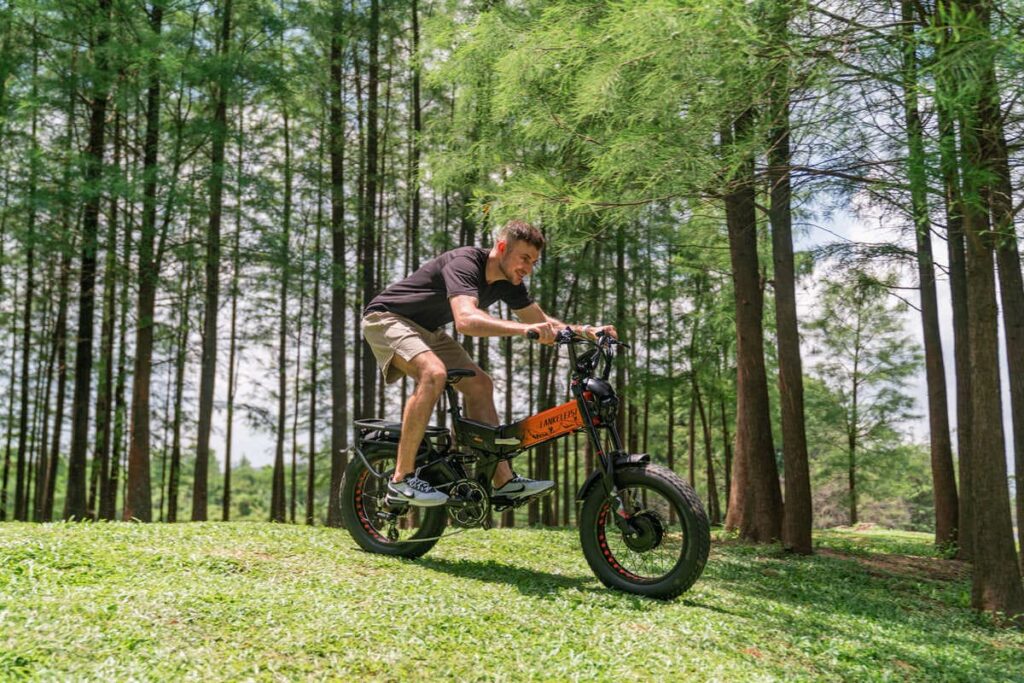
Le X3000 MAX, it is a concentrate of power in a format folding. Yes, you read that right: a Folding electric mountain bike dual-engine, with 20-inch fat tires, ideal for those who want an easy-to-transport bike without compromising on performance.
With two 1000 W motors each, it swallows up hills and rough paths without flinching. It is the perfect companion for urban adventurers as well as for lovers of slightly wilder trails, while maintaining real versatility and the ability to slip into a trunk or a small space.
LANKELEISI MG800Max: muscle and stability

If you are looking for a high-powered mountain bike, so take a look at the MG800Max. Here, no half measures: this model also includes two 1000 W motors eachi.e 2000 W of total torque, for a impressive traction, even on the most demanding slopes.
Its 26-inch fat tires assure him excellent stability, even on soft ground (sand, snow, mud), and its high-capacity battery allows you to go far without worrying about returning. It's a real all-terrain tank, designed for those who want to go all over, And especially without limits.
Our final tips before you get started
Finally, here are some tips to avoid unpleasant surprises:
- Test if possible the bike before purchase (some shops or events offer test rides).
- Check the weight of the bike, especially if you have to carry it around often.
- Think about maintenance : an electric mountain bike requires a little more care than a classic bike, especially for the battery and electrical connections.
- And especially… have fun !
Conclusion: The right electric mountain bike is the one that makes you want to go out
Choosing an electric mountain bike isn't just about checking technical boxes or following the advice of a hasty salesperson. It's about taking the time to find the bike that fits your riding style, your desires, and your terrain.
Whether you're curious, a weekend adventurer, or a fan of technical trails, there's a model made for you. Suspension, engine, range, tires: they all matter, of course. But ultimately, the right choice is the one that makes you want to get on your bike as soon as you have an hour to spare, whether it's for an impossible climb, a greasy descent, or just a breath of fresh air in the local forest.
And remember: with an e-MTB, the machine doesn't do everything—you decide the pace, the route, and the fun. So, test it, explore, and most importantly... have fun.