



On busy city streets and country roads alike, good visibility is essential for safe driving. Automotive lighting systems have undergone a profound transformation in recent years. Today, a headlight no longer simply provides light; it has become an active tool for road safety.
Smarter, more efficient headlights
Models like the Renault Twingo II now feature advanced features like automatic high beam. This system detects the environment (night, tunnel, weather conditions) and automatically adjusts the intensity of the headlights. It reduces glare for other drivers while ensuring optimal visibility for the driver.
According to Piecesauto, the Twingo 2's headlight technology contributes to improve the perception of obstacles and to strengthen night-time safety, particularly in urban areas.
LED and Matrix LED headlights are gradually replacing traditional halogens. They provide a whiter light, closer to daylight, making it easier to see obstacles, signs, or pedestrians. In addition, their range is often automatically adjustable depending on vehicle speed and road conditions.
Comparison of range between headlight technologies
| Headlight type | Medium range | Energy consumption | Average life |
| Classic halogen | 50 70-m | Élevée | ~ 500 h |
| LED | 100 150-m | Low | ~15 h |
| MatrixLEDs | >150 m | Moderate | ~30 h |
Essential coordination between lighting and driving aids
Advanced Driver Assistance Systems (often referred to by the acronym ADAS), such as emergency braking, lane keeping assist, and adaptive cruise control, rely heavily on the quality of the vehicle's visual perception. For proper operation, the onboard cameras and sensors must analyze a well-lit environment.
Insufficient or poorly directed lighting can distort the data collected, with direct consequences for the effectiveness of these systems. For example, a pedestrian who is difficult to see at night may not be detected in time. Thus, headlight performance directly influences the responsiveness and reliability of driver assistance technologies.
The role of DSRC communication in anticipation
DSRC (Dedicated Short-Range Communications) technology allows vehicles to communicate with each other and with road infrastructure (traffic lights, smart signs). These real-time exchanges warn the driver of imminent dangers, such as sudden braking by an oncoming vehicle or the presence of an obstacle in the lane.
Here again, lighting plays an indirect role: the recognition of signs or road markings by optical sensors depends on the ambient light and that provided by the vehicle.
An evolution to serve all users
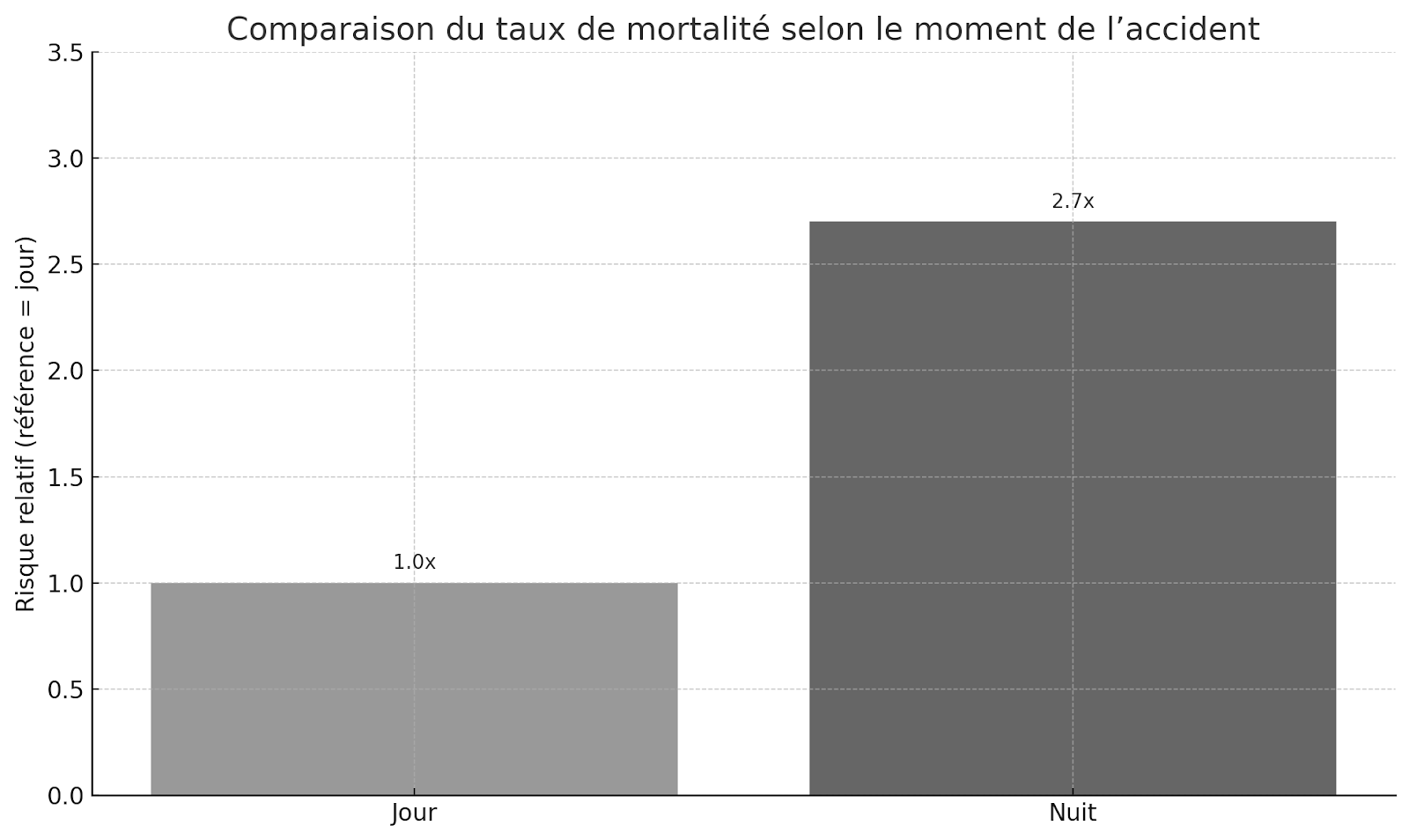
Improved lighting doesn't just benefit drivers. Pedestrians, cyclists, and other road users also benefit from improved visibility. Studies conducted by the European Road Safety Council (ETSC) show that nighttime accidents are two to three times more likely to be fatal than those occurring during the day.
Mortality rate by time of accident
Conclusion
Automotive lighting technology is no longer a mere convenience; it's a central pillar of modern safety. Its evolution parallels that of driver assistance systems and actively contributes to reducing the risk of accidents. For manufacturers and users alike, investing in good lighting is an investment in prevention.